
Marlene Flyer 103 px  

Der verlorene Mantel. Marlène Goldstein und die Odyssee einer Familie aus Baden und dem Elsass im Strom der Zeit 
Le manteau perdu. Marlène Goldstein et l’odyssée d’une famille du pays de Bade et d’Alsace au fil du temps 
The Lost Coat. Marlène Goldstein and the Odyssey of a Family from Baden and Alsace in the Currents of History.
Essayfilm (105 min.). Premiere 23-07-2026, KG1 HS 1010, Universität Freiburg / The Freiburg University 

Weitere Aufführungen  18-10-2026: Rathaus/Historisches Kaufhaus Freiburg, Zentraler Gurs-Gedenktag (voraussichtl. nicht-öffentlich)  –  09-11-2026: Kulturamt Sulzburg, Alte Synagoge, 18 h  –  20-11-2026: Festsaal Illenau / Stadtarchiv Achern, 18 h. – Weitere Informationen folgen.
Prochaines séances  18 oct. 2026 Hôtel de Ville de Fribourg, Commémoration centrale de Gurs 2026 (prévisionnellement non publique)  –  09 nov. 2026: Service culturel de Sulzburg, Ancienne synagogue, 18 h  –  20 nov. 2026: Salle des fêtes d’Illenau à Achern, 18 h. Informations complémentaires à suivre.
Upcoming venues  18 Oct. 2026: Freiburg City Hall, Central Gurs Commemoration Ceremony 2026 (provisionally not open to the public) –  9 Nov. 2026: Sulzburg Cultural Office, Old Synagogue, 6 pm –  20 Nov. 2026: Illenau Festival Hall, Achern, 6 pm. – More details to follow.

Ausgehend vom bronzenen Mantel-Mahnmal beim Freiburger Hauptbahnhof erzählt dieser Film die Geschichte des Mädchens, das im Sommer 1940 während der NS-Zeit im Alter von knapp zehn Jahren dem Internierungslager Gurs am Fuß der Pyrenäen entkam, mit seinen Eltern eine außergewöhnliche Flucht-Odyssee durch Frankreich überlebte und nach dem Zweiten Weltkrieg zur Ersten Staatsanwältin in Freiburg wurde. Mit dokumentarischen und kreativ-experimentellen Mitteln – historischem Foto- und Filmmaterial, KI-Animationen und Liedern – zeichnet der Film Lebenswege, geprägt von Hoffnung und Überleben ebenso wie von Verfolgung und Tragik, über drei Generationen einer Familie bis zu ihren Ursprüngen in der Zeit des Deutsch-Französischen Kriegs 1870/71 nach, als die Großeltern ins Elsass zogen.
Der Film basiert auf einer langjährigen Bekanntschaft mit Marlene Goldstein-Steinhauer (1930–2025), gemeinsamen Sichtungen früher Filmfassungen sowie auf dem persönlichen Nachlass, der dem Filmemacher von ihrem Sohn vertrauensvoll zur Verfügung gestellt wurde. Die erste filmische Familiensaga aus Freiburg und der Oberrheinregion – berührend, fesselnd und tief bewegend.

 Partant du Mémorial du Manteau en bronze situé près de la gare centrale de Fribourg, ce film raconte l’histoire d’une jeune fille qui, à l’été 1940, sous le régime nazi, alors âgée de presque dix ans, s’échappa du camp d’internement de Gurs, au pied des Pyrénées. Avec ses parents, elle survécut à une extraordinaire odyssée de fuite à travers la France et devint, après la Seconde Guerre mondiale, la première femme procureure de Fribourg.

À travers une approche à la fois documentaire et créative-expérimentale — photographies et films d’archives, animations générées par IA et chansons — le film retrace, sur trois générations d’une même famille, des destins marqués aussi bien par l’espoir et la survie que par la persécution et la tragédie, jusqu’à leurs origines à l’époque de la guerre franco-prussienne de 1870-1871, lorsque les grands-parents s’installèrent en Alsace.
Le film s’appuie sur une longue relation d’amitié avec Marlene Goldstein-Steinhauer (1930-2025), sur des visionnages communs de premières versions du film ainsi que sur les archives personnelles que son fils a confiées au réalisateur. La première saga familiale cinématographique de Fribourg et de la région du Rhin supérieur — bouleversante, captivante et profondément émouvante.

Starting from the bronze Coat Memorial near Freiburg Central Station, this film tells the story of the young girl who, at the age of almost ten, escaped the Gurs internment camp at the foot of the Pyrenees during the Nazi era in the summer of 1940, survived an extraordinary odyssey of escape across France with her parents, and, after the Second World War, became First Public Prosecutor in Freiburg. Combining documentary and creatively experimental approaches—including historical photographs and film footage, AI-generated animations, and songs—the film traces lives shaped by hope and survival as well as by persecution and tragedy across three generations of one family back to their origins in the era of the Franco-Prussian War of 1870–71, when her grandparents moved to Alsace.
The film is based on a long-standing acquaintance with Marlene Goldstein-Steinhauer (1930–2025), private screenings of early cuts of the film, and the personal archive entrusted to the filmmaker by her son. The first cinematic family saga from Freiburg and the Upper Rhine region—moving, compelling, and deeply touching.


Das Höllentor von Auguste Rodin / The Gates of Hell by Auguste Rodin, 40 min.
Ein Essayfilm über das Hauptwerk des französischen Bildhauers, an dem er von 1880 bis zu seinem Tod 1917 arbeitete. Einer meiner längsten Filme aus einer Reihe zahlreicher weiterer Arbeiten über Kunst und Künstler:innen, entstanden 2017 im Zusammenhang mit dem Buch Grundkurs Kunst 2 / An essay film on the central work of the French sculptor, which occupied him from 1880 until his death in 1917.
One of my longest films in a larger series of works devoted to art and artists, produced in 2017 in conjunction with the book Grundkurs Kunst 2 (Basic Course on Art, vol. 2) 


Peter Weibel: airtext, 1967/2003
Konzeptkunst-Aktion von Peter Weibel im ZKM Karlsruhe, reinszeniert von Michael Klant für die DVD „Kunst in Bewegung“ / Re-enactment of a conceptual piece by Peter Weibel, staged at the ZKM Karlsruhe by Michael Klant for the DVD „Art in Motion“
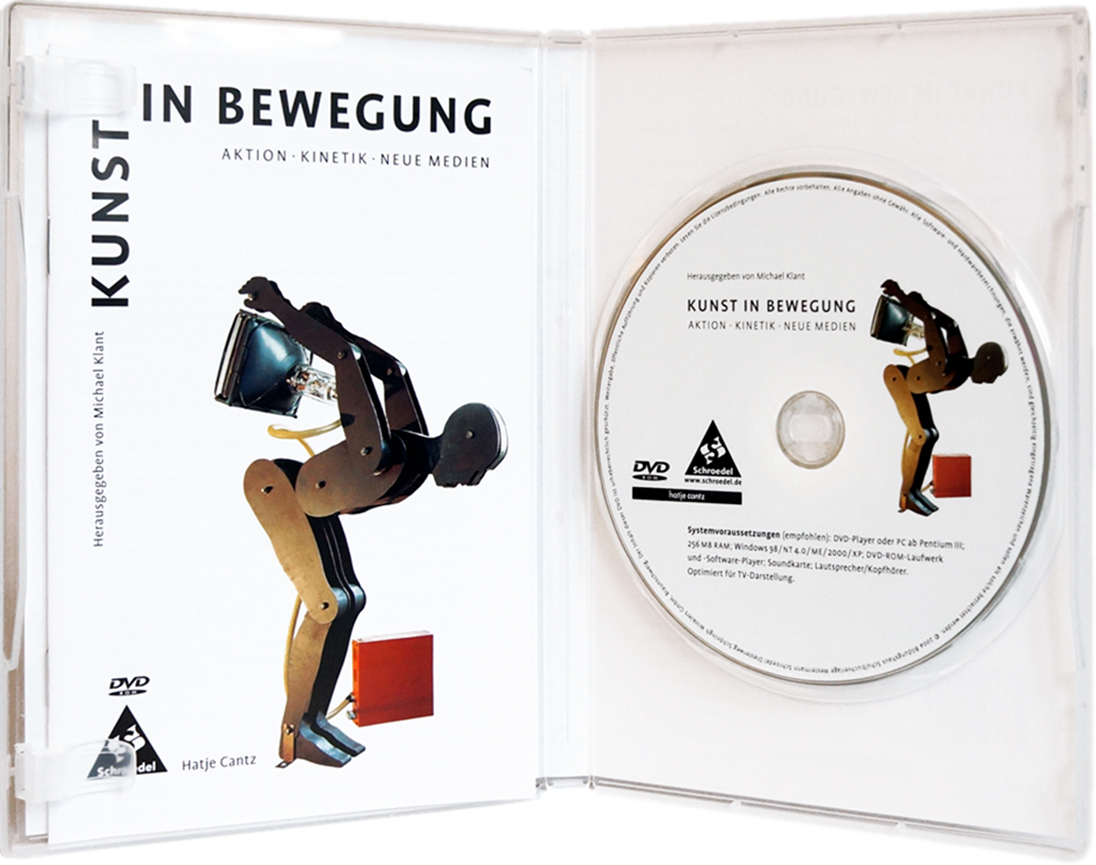
 
 
GKK 4 DVD 700 89     
 
Kunst in Bewegung. Aktion – Kinetik – Neue Medien / Art in Motion. Performance – Kinetic Art – New Media. DVD, Schroedel, Hatje Cantz 2004  
 
70 Kurzfilme über Kunst und Künstler / 70 short films on art and artists

30 Filme als Eigenproduktionen, unter anderem zu / 30 own productions, among them:
Vito Acconci, Carl Andre, Jonathan Borofsky, Alexander Calder, Gunter Demnig, Thomas Hirschhorn, Jenny Holzer, Rebecca Horn, Stephan von Huene, Bruce Nauman, Nam June Paik, Otto Piene, Fabrizio Plessi, George Rickey, Jeffrey Shaw, Jean Tinguely, Peter Weibel

40 Filme zu Künstlern und deren Werken auf der Basis vorhandenen Materials von Michael Klant neu editiert und teilweise kommentiert, darunter / 40 films re-edited and partly commented on artists like:
Marina Abramovic & Ulay, Joseph Beuys, Christo & Jeanne-Claude, Jochen Gerz, Karl Otto Götz, William Kentridge, Maria Lassnig, Richard Long, Shirin Neshat, Ursula Neugebauer, Benjamin Patterson, Ulrike Rosenbach, Niki de St. Phalle, Robert Smithson, Timm Ulrichs, Franz Erhard Walther
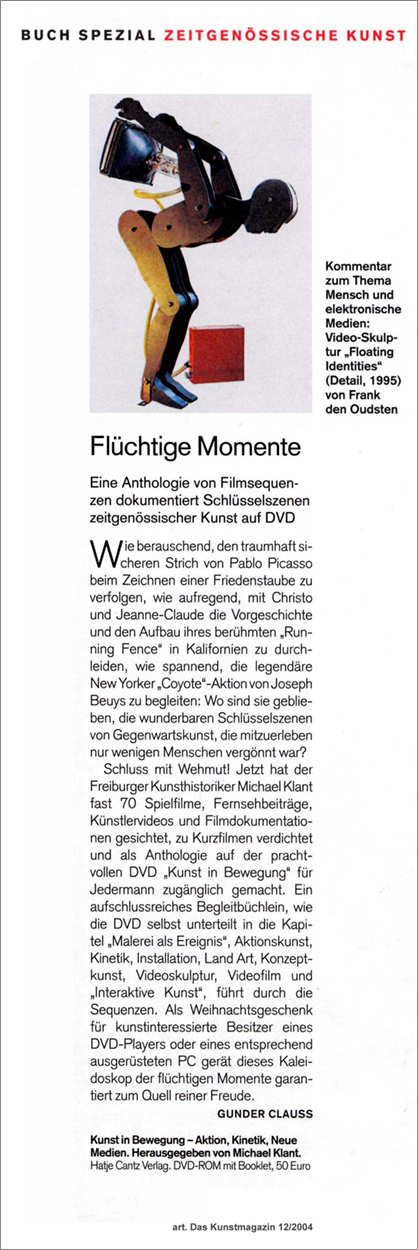
 
 
Spätere Produktionen umfassen Filme über Joseph Beuys' 7000 Eichen oder die Large-scale Skulpturen von Claes Oldenburg und Coosje van Bruggen ebenso wie Atelierbesuche, z.B. bei Stephan Balkenhol, in vielen Fällen zusammen mit Raphael Spielmann. / Later productions comprise short films on Joseph Beuys' project 7000 Oaks or on the large-scale sculptures by Claes Oldenburg and Coosje van Bruggen as well as studio visits, e.g. with Stephan Balkenhol, often together with Raphael Spielmann.
 
→ siehe Menüpunkt / see menu item Photowork, Artists